
Tools mentioned in this article
Open the browser-based tool while you read and try the workflow immediately.
When you design server or cloud networks, questions like “how many hosts fit in this /24?” or “which address is the broadcast?” come up constantly. The IP/CIDR Subnet Calculator takes CIDR notation such as 192.168.1.10/24 and instantly breaks the network down — entirely in your browser.
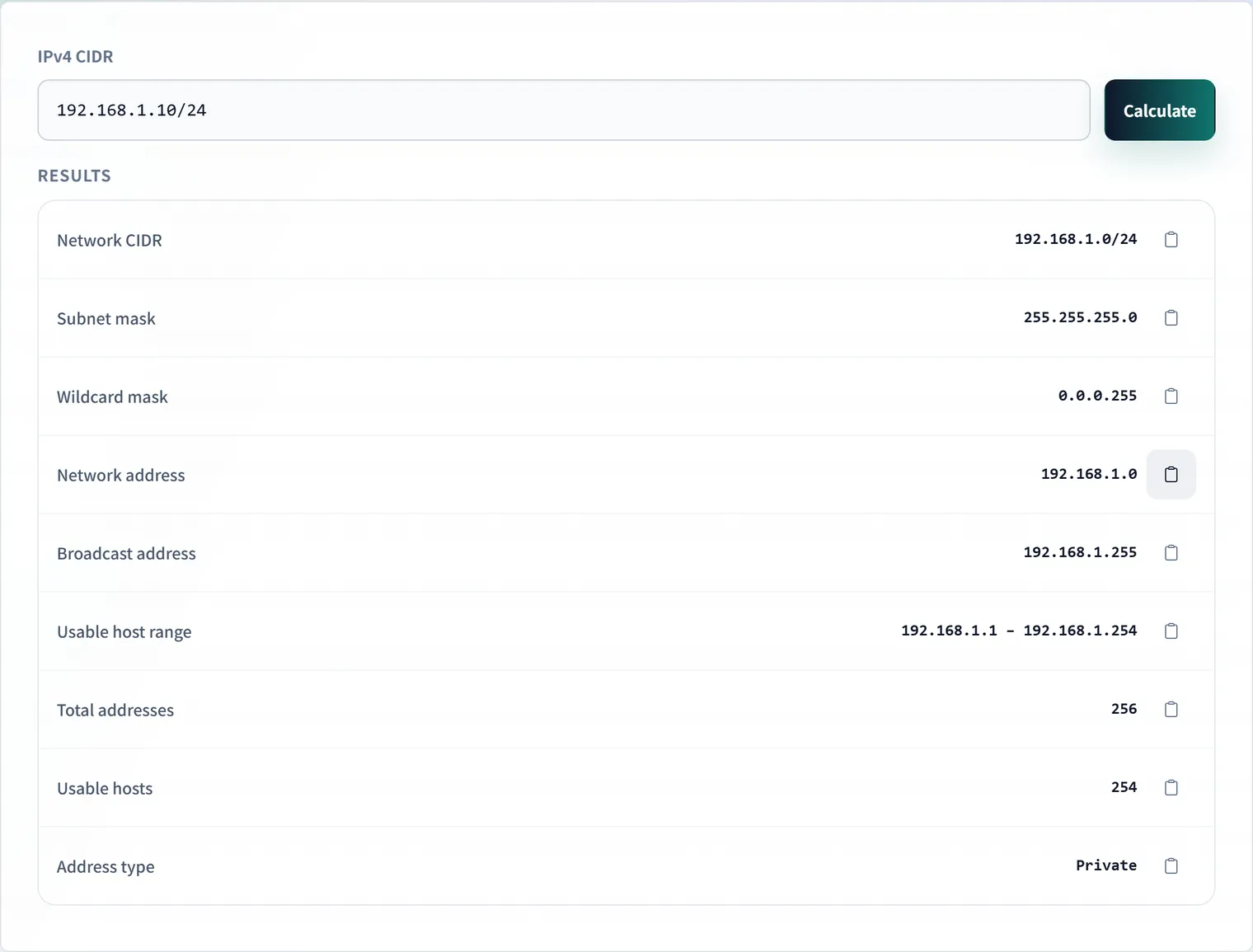
CIDR and subnet basics
CIDR (Classless Inter-Domain Routing) notation expresses an IP address and prefix length as address/prefix. The prefix length says how many leading bits form the network portion; the remaining bits are the host portion.
For example, /24 means the first 24 bits are the network and the remaining 8 bits are hosts. With 8 host bits, the subnet contains 2^8 = 256 addresses. The first one (the network address) and the last one (the broadcast address) cannot be assigned to hosts, so the number of usable hosts is 256 − 2 = 254.
Prefix length cheat sheet
The prefixes you will reach for most often:
| Prefix | Subnet mask | Total addresses | Usable hosts |
|---|---|---|---|
| /24 | 255.255.255.0 | 256 | 254 |
| /25 | 255.255.255.128 | 128 | 126 |
| /26 | 255.255.255.192 | 64 | 62 |
| /27 | 255.255.255.224 | 32 | 30 |
| /28 | 255.255.255.240 | 16 | 14 |
| /29 | 255.255.255.248 | 8 | 6 |
| /30 | 255.255.255.252 | 4 | 2 |
Worked example: 192.168.1.10/26
/26 leaves 6 host bits (2^6 = 64 addresses). Splitting 192.168.1.0/24 into 64-address blocks, 192.168.1.10 falls into the first block:
- Network address:
192.168.1.0 - Broadcast address:
192.168.1.63 - Usable host range:
192.168.1.1–192.168.1.62 - Subnet mask:
255.255.255.192 - Wildcard mask:
0.0.0.63
The wildcard mask is the bit-inverse of the subnet mask, used to specify ranges in ACLs (access control lists) on Cisco-style equipment.
The /31 and /32 special cases
Normally two addresses (network and broadcast) are excluded, but two prefixes are exceptions:
- /32: a single host. Used when targeting exactly one address, e.g. host routes or ACL entries.
- /31: defined by RFC 3021 for point-to-point links. No network/broadcast addresses are reserved, so both addresses are usable — a common address-saving choice for router-to-router links.
The IP/CIDR Subnet Calculator handles both special cases correctly when computing host counts.
What the tool calculates
- Network and broadcast addresses
- Usable host range (first–last), total and usable counts
- Subnet mask (dotted decimal) and wildcard mask
- RFC 1918 private / loopback / link-local detection
- One-click copy for every value
Everything you type is processed inside your browser and never sent to a server, so it is safe to use with internal network and production addressing plans.
FAQ
Why is the usable host count 2 less than the total?
In a normal subnet, the first address (network) and the last address (broadcast) cannot be assigned to hosts. A /24 therefore has 256 total addresses but 254 usable hosts. The exceptions are /31 and /32, as described above.
Does it support IPv6?
Currently the calculator supports IPv4 only. IPv6 addresses such as 2001:db8::/32 are not supported.
Are the IP addresses I enter sent anywhere?
No. All calculations run in JavaScript inside your browser; nothing you enter is transmitted to a server.